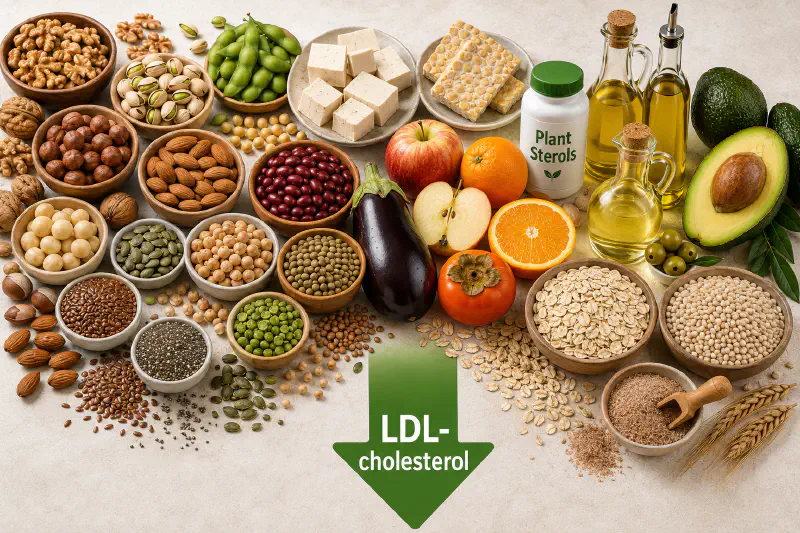
High levels of “bad” cholesterol are the most important cardiovascular risk factor. But is it possible to lower it through diet alone? In this article I’ll try to clarify cholesterol’s functions, the difference between “good” and “bad” cholesterol, and the diet that has shown the best results in reducing it.
Is Cholesterol Our Worst Enemy?
No, in fact, we need it. Cholesterol is a fundamental molecule that our body produces on its own, mainly in the liver. It serves as a precursor for steroid hormones (cortisol, testosterone, progesterone, etc.), vitamin D, and the bile salts needed to digest fats. The problem arises when the liver produces, or the body absorbs, more than it needs.
This is where the two acronyms that make all the difference come in: LDL and HDL. These aren’t two different types of cholesterol, but two “means of transport” that move it through the blood in opposite directions. LDL are low-density lipoproteins that carry cholesterol from the liver to the tissues, while HDL (high-density) make the reverse journey, bringing excess cholesterol back to the liver to be eliminated. This is why the cholesterol carried by LDL is called “bad” and the one carried by HDL is called “good.”
When LDL cholesterol is in excess and becomes oxidized, it tends to deposit on artery walls, leading to the formation of atherosclerotic plaques. With these plaques, blood vessels become stiffer, and their rupture can lead to complete blockage of certain arteries and, as a result, cardiovascular events such as strokes and heart attacks.
As a general reference, the American Heart Association recommends total cholesterol below 200 mg/dL (5.2 mmol/L), LDL below 100 mg/dL (2.6 mmol/L), and HDL above 60 mg/dL (1.6 mmol/L). The European ESC/EAS guidelines, on the other hand, don’t use the same fixed thresholds for everyone: the LDL target depends on individual cardiovascular risk and can go as low as under 55 mg/dL (1.4 mmol/L) in high-risk individuals. In practice, your “right” number is determined by your doctor based on your risk profile, not a generic chart.
Combining the Strength of Different Foods with the Portfolio Diet
In the 2000s, Canadian researcher David J.A. Jenkins, of the University of Toronto, made a simple observation: if some individual foods have moderate effects on lowering LDL cholesterol, what happens if we put them all on the same plate?
The idea took its name from the financial meaning of the word “portfolio.” As in investing, instead of betting everything on one miracle food, you diversify across several “assets” that have already proven to work, adding up their effects.
Among the foods that showed the highest degree of evidence were foods:
rich in healthy fats (polyunsaturated and monounsaturated) and low in unhealthy (saturated and trans) fats,
rich in soluble, viscous fiber,
fortified with plant sterols or stanols.
Anyone wanting to dig deeper can take a look at this umbrella review, which summarized dozens of studies on the effects of individual foods on LDL cholesterol.
It really was a brilliant intuition. Picture a coach who assembles all the most promising players and ends up with a genuinely winning team.
A series of randomized controlled trials (the most robust kind) have been conducted on patients with elevated cholesterol levels. These studies demonstrated the effectiveness of the Portfolio diet, showing a roughly 30% reduction in LDL cholesterol. One study that directly compared the diet with drug therapy also showed that the reductions achieved with the diet (-28.6%) were similar to those seen with 20 mg of lovastatin (-30.9%). For those who don’t know, lovastatin belongs to the class of drugs called statins, used to reduce cholesterol synthesis by the liver.
The evidence on the Portfolio Diet as a whole is summarized in this meta-analysis, which pooled several trials conducted on people with hypercholesterolemia, comparing the Portfolio Diet (added to a diet already low in saturated fat) with a control diet. This analysis found an LDL reduction of about 17%, along with significant improvements in other metabolic parameters, blood pressure, C-reactive protein (a marker of inflammation), and estimated 10-year cardiovascular risk. No effect was observed on HDL or body weight, since this was not a calorie-restricted diet.
The “Big Five” in the Fight Against LDL Cholesterol
So how is the Portfolio Diet built?
1. Nuts and seeds: 45 g per day
A handful of almonds, walnuts, pistachios, or seeds (pumpkin, flax, chia, sesame). Contrary to popular belief, they don’t cause weight gain when included as part of a balanced diet. They’re perfect for replacing less healthy snacks or adding to salads, cereals, or soy yogurt.
2. Plant protein: 50 g per day
Calculating protein intake precisely would take some extra math, but to simplify, this quantity roughly corresponds to about 200 grams of dried legumes. Note, though, that plant protein is also found in several other foods, such as grains, tofu, tempeh, soy milk, and soy yogurt. By combining multiple protein sources throughout the day, you can reach 50 g without much effort.
3. Viscous fiber: 20 g per day
This is a “gelling” type of fiber, the kind that slows down cholesterol absorption in the gut. Among the richest sources are: oats, barley, psyllium, but also eggplant, okra, apples, citrus fruits, and berries. A spoonful of psyllium in water or a smoothie is the quickest way to hit this amount.
4. Plant sterols: 2 g per day
These are naturally found in small amounts in legumes, vegetables, nuts, and vegetable oils, but reaching 2 g almost always requires fortified foods (margarines, yogurts, juices) or a supplement.
5. Unsaturated fats: 45 g per day
Among the foods richest in unsaturated fats are various vegetable oils (extra virgin olive, canola, high-oleic sunflower, flaxseed) and sources like avocado. The goal is to replace saturated fats (fats from meat and dairy, butter, lard) rather than adding these fats on top.
For practical recipes, you can check the dedicated section of PortfolioDiet.app and the resources from the Canadian Cardiovascular Society.
What If I Can’t Follow It Perfectly?
Good news: a multicenter study showed that even partial adherence, around 50%, still produces a significant LDL cholesterol reduction of about 15%. So even incorporating some of the food groups already brings real benefits.
What Scientific Societies Say About the Portfolio Diet
In their 2015 consensus statement in the European Heart Journal, the European Atherosclerosis Society (EAS) panel acknowledged that viscous fiber and foods fortified with sterols or stanols reduce LDL cholesterol by about 7% and 10%, respectively. It also emphasized that the Portfolio Diet has the potential to reduce LDL cholesterol by 20-25%, identifying this approach as valid both on its own and in combination with statins or other lipid-lowering drugs.
Key Points
Cholesterol isn’t an enemy: the problem is excess LDL cholesterol and its oxidation. Targets should be personalized with your own doctor.
The Portfolio Diet combines five food groups already individually effective at lowering LDL cholesterol, taking advantage of their additive effect.
Studies estimate an LDL cholesterol reduction of about 17-30%, depending on overall patient adherence.
Even partial adherence brings measurable benefits, up to a 15% reduction.
It is recognized by scientific societies both as a first-line treatment and as a complement to drug therapy.